The Scale of the Problem Nobody Talks About
Sub-Saharan Africa is home to more than 44 million micro, small, and medium enterprises. These businesses collectively employ more people than any other sector on the continent. They are the backbone of local economies from Nairobi to Lagos to Accra. They feed families, fund school fees, and drive entire neighbourhoods.
And the vast majority of them have no idea whether they are actually making money.
That is not an exaggeration. Survey after survey, including research from the International Finance Corporation and the African Development Bank, consistently finds that fewer than 20 percent of small business owners in sub-Saharan Africa keep any form of structured financial records. The rest are operating on memory, instinct, and a rough mental tally that gets harder to maintain with every new customer, supplier, and product line.
The question is not whether these business owners are smart or hardworking. They absolutely are. The question is why every financial tool ever built has failed to reach them, and what needs to change.
What Actually Happens When You Run a Business Without Proper Books
Picture a woman who runs a clothing boutique in Kampala. She opens at eight in the morning, handles ten to thirty customers a day, sells on credit to her regulars, pays three suppliers on different terms, and manages a small stock room on her own. She works six days a week and has done so for seven years.
She keeps a handwritten book. In it she jots down the day's sales when she remembers to. Some days she forgets. Some pages get wet. Some entries are incomplete because a customer interrupted her mid-sentence. At the end of the month, she adds up what she can and tries to figure out whether she is ahead or behind.
She almost never knows for certain. And she is far from alone.
The problems that come from this situation are not abstract. They are specific and costly.
Invisible Profit Leaks
When you cannot see your numbers in real time, you cannot see where money is disappearing. A supplier quietly raises prices by eight percent. A product line that used to be profitable stops being profitable because input costs rose. A customer who buys on credit has not paid in three months and the debt has quietly grown to a figure that could wipe out an entire month of profit.
None of these things announce themselves loudly. They leak. They erode margins gradually and invisibly. By the time most business owners notice, the damage is already done and often significant.
Research from the World Bank's Enterprise Surveys found that cash flow problems are the single largest reported barrier to growth for small businesses in Africa, above even access to financing. The two are connected. Poor visibility creates cash flow problems, and cash flow problems prevent growth.
Credit Exclusion
The African Development Bank estimates that small businesses in Africa face a financing gap of more than 330 billion US dollars. A large portion of that gap exists not because lenders are unwilling in principle, but because businesses cannot demonstrate their financial health.
Walk into a bank or approach a microfinance institution and the first thing they ask for is financial statements. Profit and loss accounts. Cash flow records. Evidence that the business generates enough revenue to service a loan. Without those records, the application goes nowhere, regardless of how long the business has been running or how loyal its customer base is.
The cruel irony is that many of these businesses are genuinely creditworthy. Their cash flows are consistent and their margins are real. But because no one has ever helped them capture and present that information in a standard format, they are locked out of financing that could help them grow, hire, and build.
Mobile lending apps have partially filled this gap in some markets, most notably Kenya with M-Pesa's credit products and similar tools in Nigeria and Ghana. But these products offer small amounts at very high interest rates and are designed for consumption, not business investment. They do not solve the structural problem of financial invisibility.
Tax Compliance Risks
As African governments invest in digital tax infrastructure, the pressure on small businesses to register, file returns, and pay taxes is growing. Kenya's KRA has expanded its digital net significantly. Ghana's GRA and Nigeria's FIRS have both introduced simplified tax regimes aimed at the informal sector.
The intention is good. But the execution assumes a level of record-keeping that most small businesses simply do not have. Business owners who want to comply cannot easily do so when they do not know what their revenue was last quarter, what expenses they can legitimately deduct, or what their profit actually was.
The result is that many business owners either avoid engaging with the tax system entirely, taking on risk they often do not fully understand, or they pay more than they should because they have no records to support legitimate deductions.
Stress, Burnout, and Decision Paralysis
There is a human dimension to this that the economic literature tends to underweight. Running a business without visibility into your numbers is genuinely exhausting. Every major decision carries extra anxiety because you are deciding without data.
Should I hire someone? I think I can afford it, but I am not sure. Should I expand the product range? I do not know which existing products are most profitable. Should I take on this large order? I am not sure I have the cash flow to cover the upfront costs.
The questions stack up and the absence of clear answers creates paralysis. Entrepreneurs who should be building and growing are instead stuck in a fog of financial uncertainty that drains their energy and confidence. This is one of the less-discussed reasons why so many promising small businesses stay small. It is not lack of ambition. It is lack of clarity.
Why Existing Software Has Failed to Solve This
This problem is not new. Software companies have been trying to serve small business accounting for decades. QuickBooks, Wave, Sage, Zoho Books, and dozens of African-built alternatives all exist and all claim to be accessible. So why has adoption among African micro and small businesses remained so low?
The honest answer is that the tools were designed for a different kind of user in a different kind of context.
The Literacy and Interface Problem
Most accounting software requires users to understand accounting concepts. Even the simplified versions use terms like accounts payable, general ledger, reconciliation, and chart of accounts. These terms are not intuitive to someone who learned to run a business by watching a parent or through trial and error. They are barriers, not gateways.
The visual interfaces present another challenge. Dashboards full of graphs, menus, sub-menus, settings, and configuration options create cognitive overhead. Learning to use the software well takes hours or days of focused effort. For a business owner who is also the salesperson, the stock manager, the delivery coordinator, and the customer service team, that kind of time investment is simply not realistic.
The Device and Data Problem
Desktop software requires a computer. Most small business owners in Africa do not use a computer at work. They use a smartphone, often a mid-range Android device. Web-based tools that are not optimised for mobile become frustrating quickly on smaller screens with slow connections.
Data costs are also a real consideration. A session in a web-based application that loads heavy JavaScript bundles, syncs in the background, and requires a stable connection is a meaningful cost in markets where data is priced per megabyte and connectivity is inconsistent. Business owners make subconscious cost-benefit decisions about which apps are worth the data spend, and accounting software has consistently lost that competition.
The Habit and Context Problem
Perhaps the most underappreciated failure mode is the habit problem. Good accounting requires consistent, timely data entry. Every sale needs to be recorded. Every expense needs to be logged. If you do it at the end of the day, you forget things. If you do it at the end of the week, you forget more.
Using a separate accounting app requires switching context. You are serving a customer, you make a sale, you take the payment, and then at some point later you need to remember to open a different app, navigate to the right screen, and enter the transaction. That friction, multiplied across dozens of transactions every day, is enough to break the habit entirely.
This is why so many business owners who start using accounting software abandon it within two months. It is not because they do not care about their numbers. It is because the tool forces them to change their workflow in ways that do not fit how they actually work.
Where Business Owners Actually Live: WhatsApp
Here is the irony at the heart of this problem. While business owners have been failing to adopt accounting tools, they have been enthusiastically adopting WhatsApp for almost every other aspect of their operations.
A 2023 study by GSMA found that WhatsApp is the most widely used app among small business owners in sub-Saharan Africa, with penetration rates above 80 percent in urban markets across Nigeria, Kenya, South Africa, Ghana, and Tanzania. Business owners use it to receive customer orders, negotiate with suppliers, coordinate deliveries, share invoices as photos, and manage staff.
The average small business owner in urban Africa is already spending several hours a day in WhatsApp conducting business. It is not just a messaging app for them. It is the operating system of their business.
This creates an obvious question. If business owners will not leave WhatsApp to use an accounting tool, what if the accounting tool came to them inside WhatsApp?
The Tellus Approach: Accounting That Speaks Your Language
Tellus is built on a single, foundational insight. The best accounting tool for a small business owner is one that fits into the way they already work, not one that asks them to change everything.
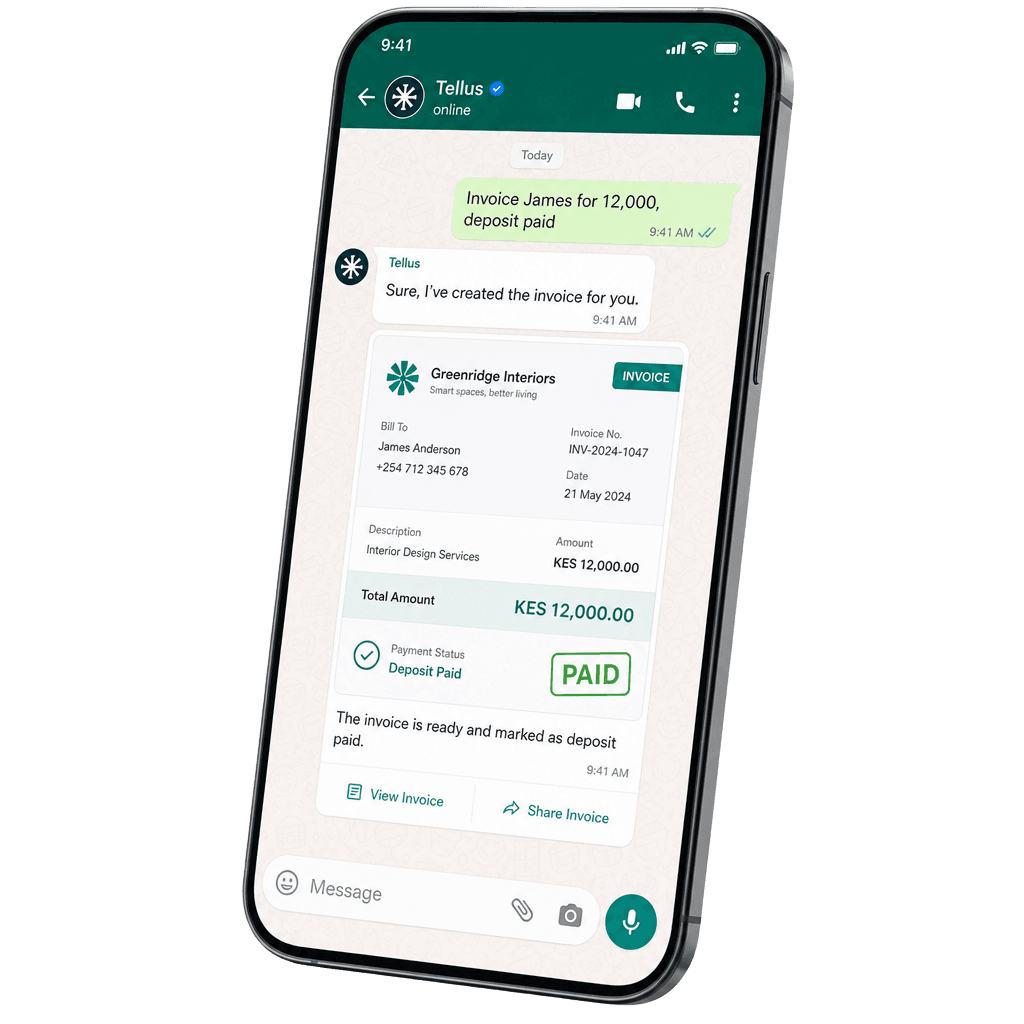
Tellus is an AI-powered accounting assistant that lives entirely inside WhatsApp. There is no app to download, no account to configure, and no dashboard to learn. You start a conversation and it starts working.
Recording Transactions in Plain Language
The way most business owners already think about their transactions is in plain language. "I sold three bags of rice to James for 4,500 shillings." "I paid 12,000 naira for electricity today." "I bought stock from my supplier for 80,000 cedis and still owe 30,000."
Tellus understands these statements. You send a message exactly like that, in your own words, and Tellus records the transaction correctly in the background. It identifies the amounts, the parties involved, the date, and the type of transaction. If something is unclear it asks a single follow-up question. If it has everything it needs, it confirms and moves on.
This is how recording a sale should work. One message. Done. No app-switching, no form-filling, no end-of-day reconciliation that you were never going to do anyway.
Invoicing Without the Work
Creating and sending an invoice is one of the most time-consuming things a small business owner does. The traditional approach involves opening software, navigating to the invoice section, entering client details, adding line items, setting payment terms, generating a PDF, and then sending it separately over WhatsApp or email.
With Tellus, you describe the invoice in a message. "Create an invoice for Greenridge Interiors, two days of interior design consulting at 15,000 shillings each, payment due in 14 days." Tellus generates a professional, branded invoice and sends it directly to your customer's WhatsApp. The whole process takes under a minute. The invoice looks polished, carries your business name, and includes the payment details your customer needs.
When the customer pays, you send another message. Tellus marks the invoice as paid, records the income, and updates your outstanding balances automatically. If the customer does not pay by the due date, Tellus can send a polite reminder on your behalf.
Daily Summaries Delivered to You
One of the most valuable features of Tellus is also one of the simplest. Every morning, Tellus sends you a brief summary of your business. How much you made yesterday. What your expenses were. Whether you are ahead or behind on your monthly target. Which invoices are still outstanding and for how long.
This summary requires nothing from you. You do not have to remember to check a dashboard or run a report. It arrives in your WhatsApp like a message from a business partner who has been watching the numbers all night and is briefing you before the day starts.
For business owners who have never had reliable financial visibility, this daily summary is often described as transformative. Knowing, consistently and accurately, whether the business made money yesterday creates a different relationship with the business. Decisions that were previously made on gut feel can now be made on fact.
Voice Notes as Input
Not everyone prefers typing. Many business owners are more comfortable speaking, particularly those who are more fluent verbally than they are in written form. Tellus supports voice notes. You can record a voice message describing a transaction, an expense, or a question about your business, and Tellus will transcribe it, understand it, and act on it exactly as if you had typed it.
This removes one of the last remaining friction points for business owners who might otherwise find text-based interaction awkward. The tool adapts to you. You do not adapt to the tool.
Real Financial Reports, Automatically
Behind the conversational interface, Tellus runs a proper accounting engine. Every transaction you record is posted correctly to the underlying ledger. This means that at any point you can ask Tellus for a profit and loss statement, a cash flow report, a breakdown of expenses by category, or a list of outstanding invoices with aging detail.
You ask for these reports the same way you record a sale: in plain language. "Show me my profit for June." "Which customers owe me money?" "What were my top five expenses last month?" Tellus generates the report and presents it in a format you can understand and act on.
These same reports can be exported in standard formats when you need them for a bank, a loan application, or a tax filing. The data that Tellus has been quietly building on your behalf is suddenly useful in every context where financial records matter.
Inventory and Supplier Tracking
Stock management is a persistent headache for product-based businesses. Knowing what you have, what is running low, what you paid for it, and what you owe suppliers requires either a dedicated person or a dedicated system. Most small businesses have neither.
Tellus tracks your inventory as a natural byproduct of recording sales and purchases. When you record a sale that includes specific products, Tellus updates your stock levels. When you record a purchase from a supplier, it updates what you have on hand and what you owe. You can ask at any time how much stock you have of a particular item, and Tellus will tell you. When a product is running low, Tellus can alert you before you run out.
Supplier relationships are tracked the same way. Every payment you make to a supplier and every delivery you receive is logged. You can see instantly what you owe each supplier, what you have paid them over time, and what is outstanding.
Why This Matters Beyond the Individual Business
It would be easy to frame Tellus purely as a productivity tool. Easier invoicing, less time on admin, faster answers to financial questions. Those things are real and valuable. But the impact goes considerably further.
When small business owners have clear financial records, they become eligible for credit they could not access before. Access to credit at fair rates, rather than predatory short-term lending, is one of the clearest paths to growth available to small businesses. A business that starts as a one-person boutique with solid financial records can, over time, demonstrate the history needed to access a business loan that allows it to expand to a second location, add staff, or invest in better equipment.
When millions of businesses build that kind of financial history simultaneously, it changes the landscape for formal lending across entire markets. Banks and development finance institutions that currently find it too costly to underwrite small business loans at scale can begin to do so when the risk profile becomes clearer.
There is also a tax revenue dimension. Governments across Africa are looking for ways to grow their tax bases as part of broader fiscal reform. Businesses that keep proper records and understand what they owe are far more likely to comply with tax obligations. Not because of enforcement, but because compliance becomes possible and understandable when you can see your own numbers.
At the individual level, there is a dignity argument that is easy to overlook. Running a business without knowing your numbers is disempowering. You are always guessing, always slightly anxious, always aware that you might be making decisions that you will later regret. Giving business owners real visibility into their own finances is not just a practical intervention. It is a form of respect for the intelligence and ambition they have already demonstrated by building something in the first place.
What Comes Next
Tellus is in the final stages of development. Our early access cohort is small on purpose. We are not chasing scale before we have built something that genuinely works for the people we are trying to serve. Every business that joins early gets direct access to our team, and their feedback shapes what we build next.
The features in the current build cover the core accounting needs: income recording, expense tracking, invoicing, supplier management, stock management, and daily reporting. In the pipeline are more sophisticated reporting tools, cash flow forecasting, multi-user access for businesses with staff, and integrations with mobile money platforms across different markets.
If you are a small business owner who has ever reached the end of a month not knowing whether you made money, or who has ever been turned down for a loan because you could not show your numbers, Tellus was built for you.
Early access is free. We will not charge during the beta phase. The people who join now are the people who will shape what Tellus becomes.
Share this article
Early access
Join the waitlist and get free access at launch
Sign up now and you will be first to know when Tellus goes live. Free to use during the entire beta phase, no credit card required.